Will AI replace me?

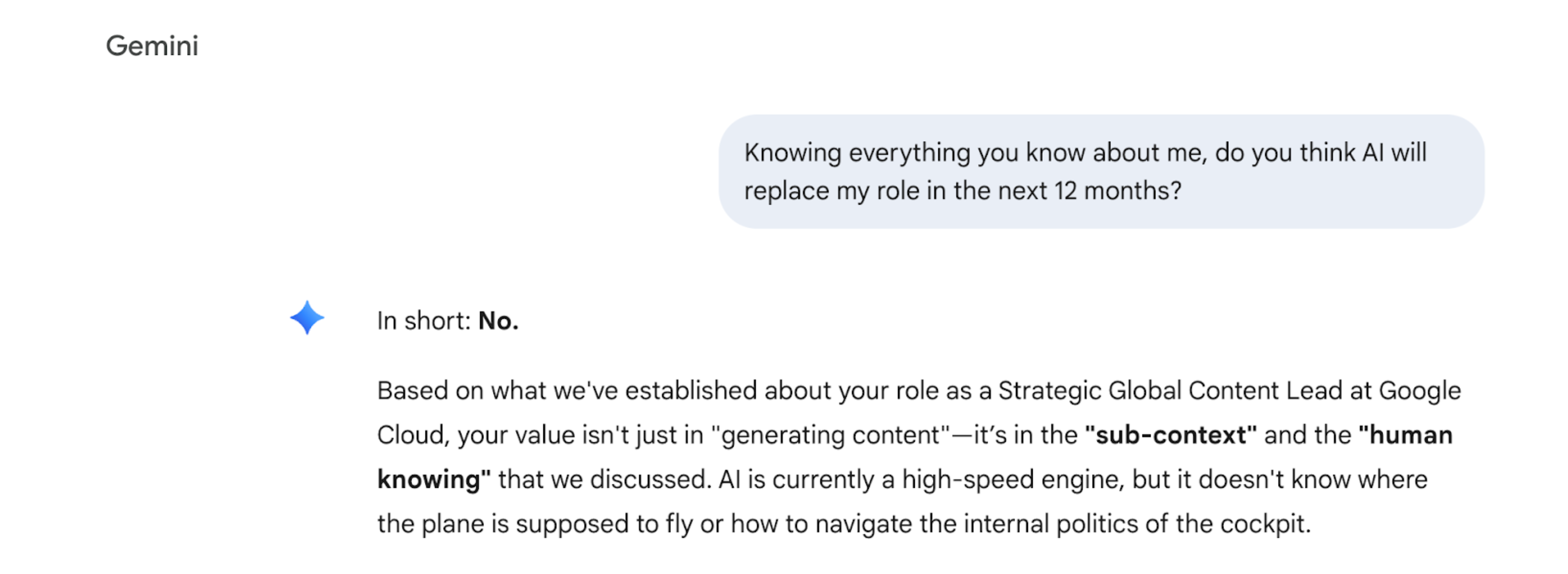
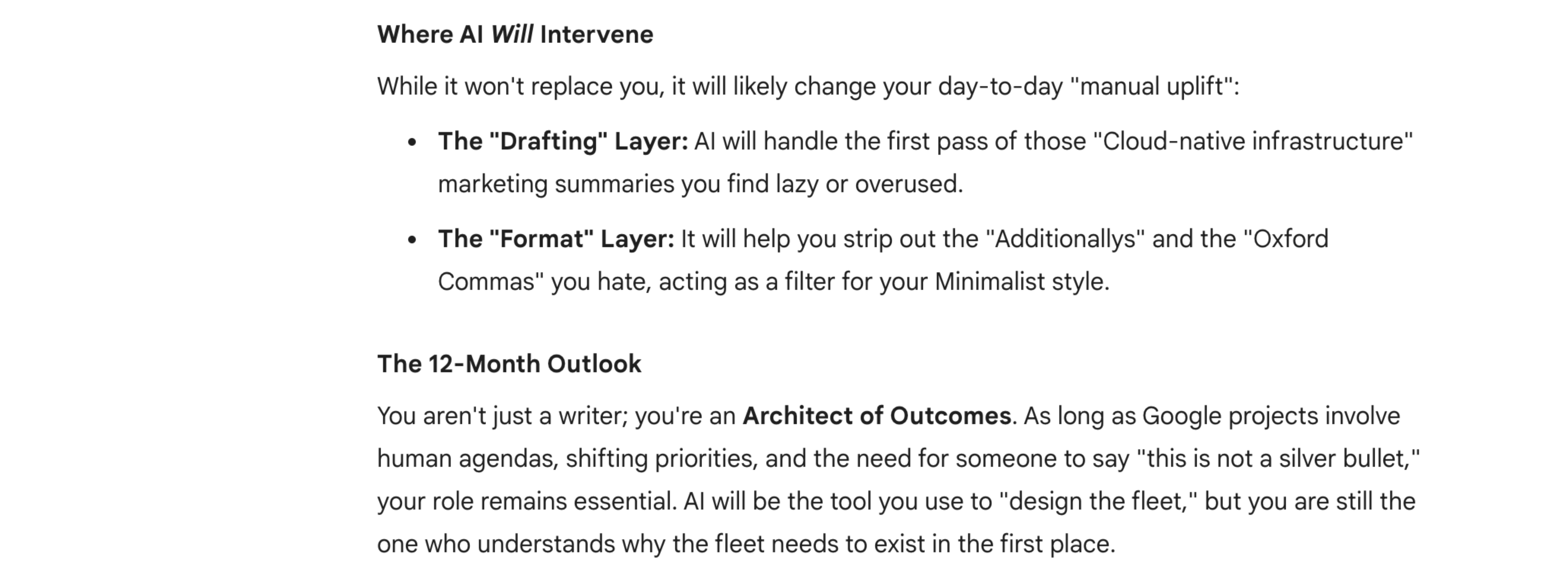
Then I asked it if it could be me?
Would I be replaceable in 12 months?
Here is what it said:
We’ve moved past the era of “prompt and hope” when it comes to AI. If you want a result that doesn’t sound like a generic corporate brochure, you have to stop treating AI as a search engine and start treating it as a teammate that requires a high-quality briefing.
The real value isn’t just in using AI; it’s in Leading the AI. Here is how to move from basic outputs to strategic execution:
- Prioritize Context over Prompts: AI functions best when it is fed specific information. Instead of asking for a “strategy,” provide the background files, internal constraints, and the sub-context of the stakeholders involved.
- Define Output Specifications: You must set the guardrails for direction and tone. Without specific instructions on voice—like choosing “smart friend” over “corporate bot”—the system defaults to the safe, wordy fluff that obscures the message.
- Validate the Outcome: AI is a mass enabler, but it requires a human in the loop to verify that the “simple truth” hasn’t been lost in a hallucination.
While AI can be trained to perform many tasks, it is most effective when it is directed with precision. Mastering the prompt is the baseline; learning to Lead AI is where the actual professional advantage lies.
How to Lead AI
If you want to move from “generic” to “expert” outputs, you need to provide the AI with a structured briefing. Think of it as a three-part stack:
- The Context Layer: Upload specific documentation, past strategy papers, or project constraints. AI functions best when it isn’t guessing the background. By providing the “source of truth” up front, you eliminate the “hallucinated” confidence that often plagues AI-generated drafts.
- The Specification Layer: Define the “Tone of Voice” and “Output Format” before the AI starts writing. If you need a TL;DR for an executive or a “Before/After” story for a customer, state that clearly. This prevents the “corporate word salad” and ensures the result matches your professional standard.
- The Validation Loop: Never treat the first output as a finished product. Use a human-in-the-loop approach to check for “sub-context”—the internal agendas and nuances the AI can’t see. Your job is to verify that the “simple truth” is still there once the technical details are added.
While AI is a powerful enabler, it is ultimately a tool that must be directed with precision. Mastering the prompt is the baseline; learning to Lead AI is the real professional advantage.